Durban, South Africa
May 3, 2010
I took a taxi with Bas and Monique. The driver was Indian, who was born and raised in Durban. The taxi company was owned by his family and he had been driving for the past 14 years. He agreed to take us out for the day for 800 Rand (about $115). As we began our drive through Durban, I noticed how hilly the country is, and how green. The downtown area is along the coast, and flat, with wide streets. Durban has the feel of a clean, neat city, well organized and easy to follow. One feels comfortable in Durban. Then one begins to notice how Durban flows in and around and atop many hills -- some quite tall. The larger streets and freeways seem to flow between the hills, and neighborhoods climb the hills right to the top, often capped by tall apartment buildings with views that stretch for miles. Durban is a very beautiful city, a welcoming city.
We drove first to the Valley of 1000 Hills, and I expected to spend some hours taking landscape photos. However, I learned that this valley was the home of the Phezulu Zulu Village, a center for traditional Zulu tribal culture and dancing. It is a beautiful area, and we were going to attend a cultural show. We arrived at 9:30, and the show began at 10:00, so we walked among a large zoo-like area containing crocodiles of all sizes from babies to some very large ones. Crocodiles live to more than 100 years of age, and one of the males was more then 100 years old. We then sat in the small café and had cappuccino while waiting for the show to begin. A group of dancers performed a very lively show about marriage -- the payment of cows as a dowry to the girl’s family and the acceptance by the girl and her family. It was a very pretty show, and then we took photos of the dancers and walked among traditional Zulu grass huts on display in a museum-like setting.
After leaving the show, we drove among the hills to view the scenery and then the driver took us to Castor Crest, a shanty town. We drove through the shanty town on a narrow road and took photographs of the makeshift houses constructed of scraps of wood, tin, plastic, and whatever other building materials the people could find. We noticed a water tap where people went to get water, and we noticed out-houses -- the common toilets. A few of the huts had an electric line stretching from the single electric line running through the shanty town, and the taxi driver said that the hook-ups were illegal. We noticed children playing and tried to take a few photos of them. After a time, the driver turned the taxi around and drove back the way he had come, and we took more photos as we left.
Next the driver took us to the new soccer stadium being constructed for the World Cup. This new stadium is built in the shape of a giant flower basket, and a funicular car runs up one side of the “handle” of the basket to a viewing platform at the top of the stadium. We rode up and took photos, and the view was beautiful, with the coast line stretching along one side of the landscape with white waves breaking along the beaches. The skyline of the city grew from the coast, leading to green hills dotted with tall apartment buildings. The scene was beautiful.
We had lunch at the stadium at an outdoor restaurant, and watched numerous school groups coming to visit the stadium. We took photos of one group of girls, about 7-8 years old, all dressed in blue uniforms, as they watched a water fountain display with its pattern of sprays. Durban has a right to feel very proud of this new stadium, constructed for the World Cup. Actually, many streets were also being widened and repaved in preparation for the World Cup.
After leaving the stadium, the driver took us on a drive through the city, to give us a feel of the city, and I enjoyed that very much. We then returned to the ship about 2:30 p.m., ahead of our 3:00 deadline prior to sailing to East London.
The weather was cool and dry and sunny and beautiful, and soon after we returned to the ship, the sky became overcast, and soon loud claps of thunder and flashes of lightening shook us as a heavy rainstorm flooded down.
Monday, May 17, 2010

Nosy Be, Madagascar
Nosy Be, Madagascar
Thursday, April 29, 2010
The poverty was shocking from the first step on land. This island reminds me of St. Lucia in the Caribbean, or perhaps Nicaragua. There is no pier, and the ship anchored in the bay, with tenders ashore. I took the “highlights” tour from the ship, and the tour was made in a non-air conditioned, 12 passenger van rather than in a bus. I sat up front with the driver to take photos. Van tours are much better than bus tours. Even before the ship stopped moving, small boats rushed to the ship from the shore, with men begging passengers to throw money to them from the ship. The captain announced that passengers should refrain from throwing money, or anything else (like bath soap or shampoo) to them; however, some passengers tossed both money and other items. Once ashore, beggars and people selling souvenirs, embroidered scarves and tablecloths, and many other items pestered passengers incessantly. I quickly got into the van and set off on the tour.
The tour guide pointed out a dilapidated building and said it was the “governor’s house”; another dilapidated building was the mayor’s house, and still another was the town administrative building. Everything was old, shabby, and run down, although some of the souvenir sales people were well dressed, in brightly colored clothes. As the van proceeded, we saw people walking everywhere and few cars or even motor bikes. Small, old Renault cars were ubiquitous and used as taxis. The island was controlled by France for a number of years, and a version of French is the language and Catholicism is the principal religion.
The first stop on the tour was the town food market, a large building in the town center where locals purchased fresh fruits, vegetables and fish. Few houses had electricity and almost none had a refrigerator; therefore, people had to buy food every day. The main street in town was lined with small shops selling items to be purchased by locals, although some souvenir shops also appeared. Nothing on the island was modern; everything was old and shabby. The tour guide said that the Somali pirates had reduced the number of cruise ships visiting the island, and the island had also lost income when the sugar cane processing plant closed three years ago. The tour guide said that the island is now really struggling economically, with no sources of income. Many of the men seemed to fish for survival.
After touring the town market, the tour van drove inland into the countryside. The road was well paved and smooth. All along the route were shanty houses built of wooden limbs and small trees; many had thatched roofs or wooden planks laid together with wide gaps. A few houses had tin roofs, often with large stones laid on top to hold the tin in place. The tour guide said that most houses had two rooms. The weather is always warm, so houses used only cloth sheets for doors. There were a few schools, and children went to school at least for a few years. The guide said most classes were large because few teachers would come to the island to teach.
The van driver stopped at one point to show us the yellow flowers from ylang-ylang trees; these trees are grown on the island and the flowers sold to perfume factories in Paris. Nosy Be is also famous for its vanilla, and I bought a small packet from a little girl as a souvenir. Later, the driver stopped the van to show us a chameleon, which was pretty and quite interesting. He then stopped at a “typical village”, and we got out for a walk. The tour guide told us about the shanty houses, made of thin trees, like a log cabin only with the “logs” in vertical rather than horizontal positions. Souvenir sellers immediately swarmed around the van, and later we saw the same sellers, who followed the tour vans from stop to stop.
At lunchtime, the vans gathered at a beautiful beach, where the ship had arranged a spread of snacks of fruit and fried shrimp, along with soft drinks and beer. A group of women did a folk dance to entertain the passengers, and I walked around taking a few photos of the beach area.
After the lunch stop, the tour vans returned to the town center for a final stop before returning to the tenders and the ship. Several of us left our van at that point and walked along main street past all the tiny shops. By that time, most of the shops had closed for the mid-afternoon siesta time, and many of the shop owners were seen sleeping in their shops or in front of their shops on the sidewalks. Small children were sleeping along with parents at the shops. We walked back to the tenders, a walk of an hour or so, stopping to take photos along, and returned to the ship.
I’m glad to have visited Nosy Be, but like St. Lucia, I would not be inclined to return.
Thursday, April 29, 2010
The poverty was shocking from the first step on land. This island reminds me of St. Lucia in the Caribbean, or perhaps Nicaragua. There is no pier, and the ship anchored in the bay, with tenders ashore. I took the “highlights” tour from the ship, and the tour was made in a non-air conditioned, 12 passenger van rather than in a bus. I sat up front with the driver to take photos. Van tours are much better than bus tours. Even before the ship stopped moving, small boats rushed to the ship from the shore, with men begging passengers to throw money to them from the ship. The captain announced that passengers should refrain from throwing money, or anything else (like bath soap or shampoo) to them; however, some passengers tossed both money and other items. Once ashore, beggars and people selling souvenirs, embroidered scarves and tablecloths, and many other items pestered passengers incessantly. I quickly got into the van and set off on the tour.
The tour guide pointed out a dilapidated building and said it was the “governor’s house”; another dilapidated building was the mayor’s house, and still another was the town administrative building. Everything was old, shabby, and run down, although some of the souvenir sales people were well dressed, in brightly colored clothes. As the van proceeded, we saw people walking everywhere and few cars or even motor bikes. Small, old Renault cars were ubiquitous and used as taxis. The island was controlled by France for a number of years, and a version of French is the language and Catholicism is the principal religion.
The first stop on the tour was the town food market, a large building in the town center where locals purchased fresh fruits, vegetables and fish. Few houses had electricity and almost none had a refrigerator; therefore, people had to buy food every day. The main street in town was lined with small shops selling items to be purchased by locals, although some souvenir shops also appeared. Nothing on the island was modern; everything was old and shabby. The tour guide said that the Somali pirates had reduced the number of cruise ships visiting the island, and the island had also lost income when the sugar cane processing plant closed three years ago. The tour guide said that the island is now really struggling economically, with no sources of income. Many of the men seemed to fish for survival.
After touring the town market, the tour van drove inland into the countryside. The road was well paved and smooth. All along the route were shanty houses built of wooden limbs and small trees; many had thatched roofs or wooden planks laid together with wide gaps. A few houses had tin roofs, often with large stones laid on top to hold the tin in place. The tour guide said that most houses had two rooms. The weather is always warm, so houses used only cloth sheets for doors. There were a few schools, and children went to school at least for a few years. The guide said most classes were large because few teachers would come to the island to teach.
The van driver stopped at one point to show us the yellow flowers from ylang-ylang trees; these trees are grown on the island and the flowers sold to perfume factories in Paris. Nosy Be is also famous for its vanilla, and I bought a small packet from a little girl as a souvenir. Later, the driver stopped the van to show us a chameleon, which was pretty and quite interesting. He then stopped at a “typical village”, and we got out for a walk. The tour guide told us about the shanty houses, made of thin trees, like a log cabin only with the “logs” in vertical rather than horizontal positions. Souvenir sellers immediately swarmed around the van, and later we saw the same sellers, who followed the tour vans from stop to stop.
At lunchtime, the vans gathered at a beautiful beach, where the ship had arranged a spread of snacks of fruit and fried shrimp, along with soft drinks and beer. A group of women did a folk dance to entertain the passengers, and I walked around taking a few photos of the beach area.
After the lunch stop, the tour vans returned to the town center for a final stop before returning to the tenders and the ship. Several of us left our van at that point and walked along main street past all the tiny shops. By that time, most of the shops had closed for the mid-afternoon siesta time, and many of the shop owners were seen sleeping in their shops or in front of their shops on the sidewalks. Small children were sleeping along with parents at the shops. We walked back to the tenders, a walk of an hour or so, stopping to take photos along, and returned to the ship.
I’m glad to have visited Nosy Be, but like St. Lucia, I would not be inclined to return.
Dubai, UAE
Dubai, UAE
Tuesday, April 20 and Wednesday, April 21
The day was very hazy as the ship made its way into the port about 9:00 a.m.; I wanted to take photos, but I could barely see the Burj Khalifa through the haze, even though it was only a few of miles from the port. As I went to breakfast, I noticed how cool the weather was, and the low humidity. We were told that the high temperature for the day would be only 29 C (about 90 F), a beautiful day, and it turned out to be hot in the sun, but pleasant and dry and beautiful in the shade.
I had wanted to take a tour of the city the first day, and go to the Burj Al Arab Hotel the second; however, I had to reverse the order because the ship was not running the Burj Al Arab tour the second day. About 10:00, the bus set off to the Burj Al Arab, down a long straight street, the Jumeirah Road. This road is the oldest part of Dubai; it was where the original houses, businesses and hotels were located. This road reminds me of lots of beach towns in America, with flat, two-story buildings on each side of the road. We were told that a mosque would appear about every 500 meters to ensure adequate places for daily prayers. On Friday, most Muslims would go to the large Jumeirah Mosque, and would go to neighborhood mosques for daily prayers. I noticed how new the buildings looked, how there were no electrical lines anywhere, and how clean everything was.
I was also overwhelmed by the number of high rise buildings on the main road, the Sheikh Zayed Road, in the distance to the East, running parallel to the Jumeirah Road. The two main roads run North/South, with the coast line like the West Coast in Florida or California; Dubai is a West Coast city.
Our first stop was the Burj Al Arab hotel, for tea. I was pretty overwhelmed by the appearance of the hotel, built to resemble a giant sail on a dhow sail boat. Inside, the hotel was overwhelming, with an atrium reaching all the way to the 25th floor. The tea was on the 27th floor, and after tea, we were permitted to take photos from several rooms, including the tea room, another dining room, and the two story ballroom. We were not permitted to take photos from the top of the atrium down toward the lobby, perhaps for safety reasons (I’m sure they didn’t want cameras to fall on guests below).
The tour of the day was supposed to include a catamaran ride to “The World” Islands; however, because of rough seas, that part of the tour was cancelled. Instead, after tea and photos, we drove to the palm island -- the little palm island -- which was the first of the palm islands to be constructed. The island was constructed as a residential area, and we were told that it is almost completely sold out and occupied. Clearly people were living in all those high rise apartments and in the thousands of single family homes built on the palm leaves of the island. It was a beautiful place. All the way out to the end of the island is the Atlantis Hotel, and the bus stopped there for photos. The water was a beautiful green color; I had never seen water that color before. It was beautiful.
After leaving Palm Island, we drove through the newly developed area near Dubai Marina, Jumeirah Village. More than 120 high rise buildings have been built in this area in the past 12 years. The area is mainly a residential area, but it also includes Universities and the high tech sector of Dubai. The entire area is planned, with a lake, a canal, and beautiful landscape design, along with buildings of incredible architecture. The new ski slope is located in the Jumeirah area, and from the outside, it looks like a giant metal tube jutting out of a large building.
Dubai is divided into two main parts -- Downtown, near Dubai Creek, and Jumeirah, which is like a bedroom suburb in America. The two areas are separated by a large industrial park area, about five miles long. In each of the two parts of Dubai, beautiful high rise buildings have been built; the new Burj Khalifa, the world’s tallest building, is located in the Downtown area, and that was the next stop of our tour.
The bus drove through the Downtown area, stopping at the Burj Khalifa for photos. This gleaming building is truly beautiful and impressive; it narrows soon and looks like a giant needle shooting into the heavens. Just in front of the Burj Khalifa, a large pond has been constructed with forced water fountain shows each night, like the ones at the Bellagio in Las Vegas. Adjacent to the Burj Khalifa is the Dubai Mall, the largest shopping mall in Dubai, with more than 1500 stores. After half an hour of photos and walking in the area, the bus returned to the ship.
In the evening, I returned to the city with some others to walk through the old section, the “Souk”, a warren of alleyways filled with small shops. The place was really bustling in the evening, as locals were out shopping for everything from food to household utensils to spices to gold. It was wonderful to experience. We stopped in a spice store to buy some saffron; the man opened a large metal container filled with dark Iranian saffron, pinched off some, and used his scale to measure out ten grams. When the woman buying the saffron protested that it was too much, the shopkeeper seemed taken aback that anyone might want less than 10 grams.
After walking for a couple of hours, we took one of the little ferry boats across Dubai “creek”, which is almost as wide as the Potomac River, to another old area to continue walking. After a time, we took a taxi to the Dubai Mall to have dinner and watch the water show in front of the Burj Khalifa. We were able to get a table at an outdoor restaurant and watched the water show three times (it goes off every half hour) while having dinner. The air was cool and dry and the show was beautiful. The show changes each time it goes off.
Wednesday, I took the ship tour of the city. The first stop was on the beach near the Burj Al Arab for great photos. The bus then drove north along the Sheikh Sayed Road, a 10 lane freeway running north/south connecting all of Dubai, back toward the Burj Khalifa. We stopped for photos outside the Jumeirah Mosque, the oldest and largest mosque in Dubai, and then the bus took us to the Dubai Museum, which, unlike most museums, was very interesting, with displays showing how people lived in the desert community a hundred years ago. We then took a ferry boat across the Dubai Creek to the souk area, where tour passengers went for a walk before the bus returned to the ship. After the bus dropped us off at the ship, I immediately took the shuttle to the Dubai Mall to purchase another photo card for my camera, and there I learned that San Disk now has faster disks than the ones I have been using. I purchased two of them, and that should be sufficient for the remainder of the trip.
What a wonderful place Dubai is. I want to go back some January for a month. Bas and Monique priced a nice studio apartment for about $2500 per month (U.S.), and that seems quite reasonable to me. Two of the passengers, Sar and Nimu, have a son living in Dubai with his new wife, and they love it. I think I would, too.
Tuesday, April 20 and Wednesday, April 21
The day was very hazy as the ship made its way into the port about 9:00 a.m.; I wanted to take photos, but I could barely see the Burj Khalifa through the haze, even though it was only a few of miles from the port. As I went to breakfast, I noticed how cool the weather was, and the low humidity. We were told that the high temperature for the day would be only 29 C (about 90 F), a beautiful day, and it turned out to be hot in the sun, but pleasant and dry and beautiful in the shade.
I had wanted to take a tour of the city the first day, and go to the Burj Al Arab Hotel the second; however, I had to reverse the order because the ship was not running the Burj Al Arab tour the second day. About 10:00, the bus set off to the Burj Al Arab, down a long straight street, the Jumeirah Road. This road is the oldest part of Dubai; it was where the original houses, businesses and hotels were located. This road reminds me of lots of beach towns in America, with flat, two-story buildings on each side of the road. We were told that a mosque would appear about every 500 meters to ensure adequate places for daily prayers. On Friday, most Muslims would go to the large Jumeirah Mosque, and would go to neighborhood mosques for daily prayers. I noticed how new the buildings looked, how there were no electrical lines anywhere, and how clean everything was.
I was also overwhelmed by the number of high rise buildings on the main road, the Sheikh Zayed Road, in the distance to the East, running parallel to the Jumeirah Road. The two main roads run North/South, with the coast line like the West Coast in Florida or California; Dubai is a West Coast city.
Our first stop was the Burj Al Arab hotel, for tea. I was pretty overwhelmed by the appearance of the hotel, built to resemble a giant sail on a dhow sail boat. Inside, the hotel was overwhelming, with an atrium reaching all the way to the 25th floor. The tea was on the 27th floor, and after tea, we were permitted to take photos from several rooms, including the tea room, another dining room, and the two story ballroom. We were not permitted to take photos from the top of the atrium down toward the lobby, perhaps for safety reasons (I’m sure they didn’t want cameras to fall on guests below).
The tour of the day was supposed to include a catamaran ride to “The World” Islands; however, because of rough seas, that part of the tour was cancelled. Instead, after tea and photos, we drove to the palm island -- the little palm island -- which was the first of the palm islands to be constructed. The island was constructed as a residential area, and we were told that it is almost completely sold out and occupied. Clearly people were living in all those high rise apartments and in the thousands of single family homes built on the palm leaves of the island. It was a beautiful place. All the way out to the end of the island is the Atlantis Hotel, and the bus stopped there for photos. The water was a beautiful green color; I had never seen water that color before. It was beautiful.
After leaving Palm Island, we drove through the newly developed area near Dubai Marina, Jumeirah Village. More than 120 high rise buildings have been built in this area in the past 12 years. The area is mainly a residential area, but it also includes Universities and the high tech sector of Dubai. The entire area is planned, with a lake, a canal, and beautiful landscape design, along with buildings of incredible architecture. The new ski slope is located in the Jumeirah area, and from the outside, it looks like a giant metal tube jutting out of a large building.
Dubai is divided into two main parts -- Downtown, near Dubai Creek, and Jumeirah, which is like a bedroom suburb in America. The two areas are separated by a large industrial park area, about five miles long. In each of the two parts of Dubai, beautiful high rise buildings have been built; the new Burj Khalifa, the world’s tallest building, is located in the Downtown area, and that was the next stop of our tour.
The bus drove through the Downtown area, stopping at the Burj Khalifa for photos. This gleaming building is truly beautiful and impressive; it narrows soon and looks like a giant needle shooting into the heavens. Just in front of the Burj Khalifa, a large pond has been constructed with forced water fountain shows each night, like the ones at the Bellagio in Las Vegas. Adjacent to the Burj Khalifa is the Dubai Mall, the largest shopping mall in Dubai, with more than 1500 stores. After half an hour of photos and walking in the area, the bus returned to the ship.
In the evening, I returned to the city with some others to walk through the old section, the “Souk”, a warren of alleyways filled with small shops. The place was really bustling in the evening, as locals were out shopping for everything from food to household utensils to spices to gold. It was wonderful to experience. We stopped in a spice store to buy some saffron; the man opened a large metal container filled with dark Iranian saffron, pinched off some, and used his scale to measure out ten grams. When the woman buying the saffron protested that it was too much, the shopkeeper seemed taken aback that anyone might want less than 10 grams.
After walking for a couple of hours, we took one of the little ferry boats across Dubai “creek”, which is almost as wide as the Potomac River, to another old area to continue walking. After a time, we took a taxi to the Dubai Mall to have dinner and watch the water show in front of the Burj Khalifa. We were able to get a table at an outdoor restaurant and watched the water show three times (it goes off every half hour) while having dinner. The air was cool and dry and the show was beautiful. The show changes each time it goes off.
Wednesday, I took the ship tour of the city. The first stop was on the beach near the Burj Al Arab for great photos. The bus then drove north along the Sheikh Sayed Road, a 10 lane freeway running north/south connecting all of Dubai, back toward the Burj Khalifa. We stopped for photos outside the Jumeirah Mosque, the oldest and largest mosque in Dubai, and then the bus took us to the Dubai Museum, which, unlike most museums, was very interesting, with displays showing how people lived in the desert community a hundred years ago. We then took a ferry boat across the Dubai Creek to the souk area, where tour passengers went for a walk before the bus returned to the ship. After the bus dropped us off at the ship, I immediately took the shuttle to the Dubai Mall to purchase another photo card for my camera, and there I learned that San Disk now has faster disks than the ones I have been using. I purchased two of them, and that should be sufficient for the remainder of the trip.
What a wonderful place Dubai is. I want to go back some January for a month. Bas and Monique priced a nice studio apartment for about $2500 per month (U.S.), and that seems quite reasonable to me. Two of the passengers, Sar and Nimu, have a son living in Dubai with his new wife, and they love it. I think I would, too.
Muscat, Oman
Muscat, Oman
Monday, April 19, 2010
Oman has only two sights -- the grand mosque and the souk. The ship stopped for only a half day, and I took the ship tour. I noticed immediately the incredible drop in humidity from India; it was like a dream to walk outside. Later the temperature reached 42 C, but in the shade, it was very comfortable. What a difference from India, and previous stops on the cruise, where the humidity was always near 100 percent. Many people ate breakfast outside in the Panorama restaurant as the ship docked. What a pleasure to have low humidity.
The bus tour went first to the mosque, the second largest mosque in the world. As the bus set out, and along the way to the mosque, I noticed the new roads and the new cars on the roads. Additional road work was underway in many places. We were told that Oman has no public transportation; however, minibus taxis operated on schedule, with scheduled stops where people waited for their taxi. These minivan taxis were plentiful, holding about 12 passengers each. Clearly, many people used these taxis to commute to work. The roads were jammed with traffic that was stop-and-go in the morning rush hour.
As the bus made its way to the mosque, I noticed that the geography of Oman is rocky hills, with the population located in the “valleys” between the rocky hills. Thus, the city seems to snake its way among the hills like an endless maze. The hills seem to be granite, so that construction on them would seem to be very difficult.
The mosque can be described only in photos; it is very beautiful, with a giant chandelier made of Swarovski crystals. All mosques are alike in several ways -- women pray in an area that is separate from the men, and all prayer rooms are a large open area where worshipers can kneel on a beautiful carpet to pray. Mosques are beautiful inside, but they are not like churches, with pews. Instead, they are open carpeted areas where those in attendance can kneel to pray. The mosque in Oman has a beautiful carpet and a beautiful chandelier, inviting attendees to kneel and pray and feel inspired.
We had been instructed prior to the tour of the mosque that everyone would be required to remove their shoes, and women would be required to cover their heads and wear long sleeved blouses so that none of their arms showed. However, some of the women had not got the message, and were not admitted because they were wearing short sleeved blouses. One insane woman on another bus raised a fuss and said the policy was “stupid”. This insult was an insult to Islam itself, and the guards took the insult very seriously. They demanded an apology from the woman and held the tour bus until they got an adequate apology from the Cruise Line as well. The woman had returned to the bus, and refused to get off to apologize; she was afraid that they were going to take her to prison. Finally, the woman was forced to get off the bus and apologize, but she held up the tour for some time. I was glad she was not on the bus I was on.
After the mosque, the tour went to the souk -- the warren of shops. I love the souks. The first one I encountered was in Istanbul in 2000, and I have enjoyed going to them since then. This one was wonderful, with shop after shop filled with wondrous items, meant mostly for locals, although also available to tourists. Shopkeepers invited all passers by to enter and look, and people from the ship were clearly buying souvenirs. I took dozens of photos in the souk, fortunately remembering to remove my lens filter first, so the photos are sharp and clear.
In the souk, almost all of the local men were dressed in disdashas, and almost all the women were wearing abayas, many with their faces covered. I took a few photos of men and women, as well as in shops. I asked, and most people did not object to my taking their photo. I wandered deep into the souk, taking several of the alleyways on my journey, and when it was time to return to the bus, I was not entirely sure how to make out way back to the bus. As I talked with several other passengers about directions, a tall, thin woman wearing an abaya with her face completely covered except for her eyes, stopped near us and then to my surprise, asked in English if we were lost and needed help. I was so stunned that I failed to ask her if I could take her photo, and I was sorry later.
The tour guide mentioned that in order to marry, young men in Oman must pay a dowry to his bride’s family. The amount varies, but is in the range of 30-40,000 U.S. dollars. He said that more than 70 percent of young Omani men are not married because they cannot afford a wife. I asked him what the young women do for husbands, and he told me that they marry Kuwaitis or young men from the United Arab Republics. He also volunteered that young men who are not married often visit “massage” parlors for sexual relief, and that these massage parlors are legal in Oman.
After leaving the souk, the bus took us to a museum of Oman history. I was not interested, so I wandered around outside, and then went to a very nice gift shop of the museum. It was a really nice gift shop, but many, or most, of the items were made in China. It was not a gift shop of Omani crafts, except for one item. Frankincense is grown in Oman, and it is a national product. It was sold in the gift shop in a variety of small containers, ready for burning.
After leaving the museum, the bus made a final stop at one of the Sultan’s seven palaces. This one was not a home, but a business office for the Sultan, who is the chief finance officer for Oman; the ministry of finance is located in adjacent buildings. I took a few photos, and then the bus made its way back to the ship. I enjoyed our brief stop in Oman.
Monday, April 19, 2010
Oman has only two sights -- the grand mosque and the souk. The ship stopped for only a half day, and I took the ship tour. I noticed immediately the incredible drop in humidity from India; it was like a dream to walk outside. Later the temperature reached 42 C, but in the shade, it was very comfortable. What a difference from India, and previous stops on the cruise, where the humidity was always near 100 percent. Many people ate breakfast outside in the Panorama restaurant as the ship docked. What a pleasure to have low humidity.
The bus tour went first to the mosque, the second largest mosque in the world. As the bus set out, and along the way to the mosque, I noticed the new roads and the new cars on the roads. Additional road work was underway in many places. We were told that Oman has no public transportation; however, minibus taxis operated on schedule, with scheduled stops where people waited for their taxi. These minivan taxis were plentiful, holding about 12 passengers each. Clearly, many people used these taxis to commute to work. The roads were jammed with traffic that was stop-and-go in the morning rush hour.
As the bus made its way to the mosque, I noticed that the geography of Oman is rocky hills, with the population located in the “valleys” between the rocky hills. Thus, the city seems to snake its way among the hills like an endless maze. The hills seem to be granite, so that construction on them would seem to be very difficult.
The mosque can be described only in photos; it is very beautiful, with a giant chandelier made of Swarovski crystals. All mosques are alike in several ways -- women pray in an area that is separate from the men, and all prayer rooms are a large open area where worshipers can kneel on a beautiful carpet to pray. Mosques are beautiful inside, but they are not like churches, with pews. Instead, they are open carpeted areas where those in attendance can kneel to pray. The mosque in Oman has a beautiful carpet and a beautiful chandelier, inviting attendees to kneel and pray and feel inspired.
We had been instructed prior to the tour of the mosque that everyone would be required to remove their shoes, and women would be required to cover their heads and wear long sleeved blouses so that none of their arms showed. However, some of the women had not got the message, and were not admitted because they were wearing short sleeved blouses. One insane woman on another bus raised a fuss and said the policy was “stupid”. This insult was an insult to Islam itself, and the guards took the insult very seriously. They demanded an apology from the woman and held the tour bus until they got an adequate apology from the Cruise Line as well. The woman had returned to the bus, and refused to get off to apologize; she was afraid that they were going to take her to prison. Finally, the woman was forced to get off the bus and apologize, but she held up the tour for some time. I was glad she was not on the bus I was on.
After the mosque, the tour went to the souk -- the warren of shops. I love the souks. The first one I encountered was in Istanbul in 2000, and I have enjoyed going to them since then. This one was wonderful, with shop after shop filled with wondrous items, meant mostly for locals, although also available to tourists. Shopkeepers invited all passers by to enter and look, and people from the ship were clearly buying souvenirs. I took dozens of photos in the souk, fortunately remembering to remove my lens filter first, so the photos are sharp and clear.
In the souk, almost all of the local men were dressed in disdashas, and almost all the women were wearing abayas, many with their faces covered. I took a few photos of men and women, as well as in shops. I asked, and most people did not object to my taking their photo. I wandered deep into the souk, taking several of the alleyways on my journey, and when it was time to return to the bus, I was not entirely sure how to make out way back to the bus. As I talked with several other passengers about directions, a tall, thin woman wearing an abaya with her face completely covered except for her eyes, stopped near us and then to my surprise, asked in English if we were lost and needed help. I was so stunned that I failed to ask her if I could take her photo, and I was sorry later.
The tour guide mentioned that in order to marry, young men in Oman must pay a dowry to his bride’s family. The amount varies, but is in the range of 30-40,000 U.S. dollars. He said that more than 70 percent of young Omani men are not married because they cannot afford a wife. I asked him what the young women do for husbands, and he told me that they marry Kuwaitis or young men from the United Arab Republics. He also volunteered that young men who are not married often visit “massage” parlors for sexual relief, and that these massage parlors are legal in Oman.
After leaving the souk, the bus took us to a museum of Oman history. I was not interested, so I wandered around outside, and then went to a very nice gift shop of the museum. It was a really nice gift shop, but many, or most, of the items were made in China. It was not a gift shop of Omani crafts, except for one item. Frankincense is grown in Oman, and it is a national product. It was sold in the gift shop in a variety of small containers, ready for burning.
After leaving the museum, the bus made a final stop at one of the Sultan’s seven palaces. This one was not a home, but a business office for the Sultan, who is the chief finance officer for Oman; the ministry of finance is located in adjacent buildings. I took a few photos, and then the bus made its way back to the ship. I enjoyed our brief stop in Oman.
Mumbai, India
Mumbai, India
April 16, 2010
The ship arrived in Mumbai on Saturday, April 16. How can I describe Mumbai? It is perhaps the most interesting place I have ever been. The one word I would use to describe Mumbai is “teeming”. Mumbai is truly a teeming city. It is like an ant hill, with untold numbers of ants, each one scurrying to accomplish its mission, moving chaotically in every direction with intense purpose, and yet not aggressive and not interfering with other ants. Men seemed more noticeable than women on the streets; crowds of men were everywhere, seemingly either gathered for work, or perhaps looking for work. Although the city is dirty, it is not filled with litter and rubbish except in the slum areas. The city seemed to be covered with a layer of dust; everything seemed to be brown and gray and black. Although there are high-rise apartment buildings, they were not so numerous as in Singapore or Kuala Lumpur, and few seemed to be new.
The ship tours of Mumbai included stops at two museums, which was not the way I wanted to spend my time in Mumbai, so I decided to try to get an individual tour guide. When we were in Chennai, I spoke with the tour guide (Gita) and she introduced me to the manager of the tour company running the tours in Chennai, and would also be running the ship tours in Mumbai. He said that he would arrange for an individual tour guide in Mumbai; however, when we arrived at the port in Mumbai, he had not spoken with them, and no tour guide was waiting. When I spoke with the representative of the tour company on the pier, I was told that an air conditioned car with a driver could be available to us for $50 for the entire day; however, we would have to wait for 45 minutes for him to arrive at the dock. We talked with taxi drivers; however, they wanted more money and also used non-air conditioned cars. I preferred to wait. After a wait of only 5 minutes, a driver appeared, driving a new Toyota minivan, fully air conditioned, and we were off.
As we drove from the ship to the gates of the dock, I realized that we would have had great difficulty finding our way out -- the distance was at least a mile through a maze of roads filled with trucks loading and unloading cargo. I was very happy that we waited for this car.
The driver first drove us along a long street toward some of the beautiful buildings built by the British a hundred years ago -- the Prince of Wales Museum, the Rajabhai Clock Tower, the Mumbai High Court, the Victoria Rail Station. As we started off, my first impression was that at 9:00 a.m., the streets were filled with cars and people walking everywhere on their way to work. People were dressed in typical Indian clothing -- women in colorful saris and men in loose white shirts and pants. We were near the docks, and it was a typically poor area, as one would expect near a port in any city.
As we drove along, we passed block after block of shanties that had been “constructed” along the street, spilling out onto the sidewalk. Families lived in these shacks, made of scrap wood, tin, plastic, and whatever other discarded materials they could find -- homes for the homeless. We also noticed lots of trash strewn everywhere. There seemed to be no trash collection system, despite the large number of people available to work.
The streets around the rail station were even more congested with traffic than previous streets. Thousands of small, black-bottom, yellow-topped taxis filled the streets, each pressing to fill every crack in the traffic. The streets did not have lane markers, and drivers squeezed into every space wide enough to permit passage. Horns were constant, although they were not loud. Drivers used their horns to let the driver ahead know of their presence, particularly when passing, and particularly motorbikes, which were numerous, but not as numerous as in Vietnam. I was amazed at the way the drivers filled every space on the road, but without touching. Often cars were only inches apart. Gita had explained in Chennai that drivers expect other drivers to be unpredictable and not to follow the “rules of the road” too closely, and since everyone drives that way, it is accepted. At one point in Chennai, the bus was forced to drive on the wrong side of the street because he could not make a sharp turn; other drivers seemed to accept his solution to the problem.
After some time, we found ourselves along Marina Road, and we stopped for photos of the beautiful waterfront, with miles of high-rise hotels and apartment buildings looking out onto the bay. It was beautiful. We passed Chowpatti Beach and stopped several times for photos. Then our driver told us that we were entering a very wealthy area, and the feeling of the area changed. The streets were lined with very large trees whose canopies reached out to cover the streets. This area was also somewhat hilly, with narrow, winding streets, and the driver said that we were in the Malabar Hill area.
Soon we noticed parked tour busses, and the driver said that we were near the Jain Temple, which we had wanted to see. He parked the car and after removing our shoes, we entered a beautiful temple. A man took our shoes and kept them for us as we entered the temple. Our driver told us that we were permitted to take photos inside the temple; however, when we entered, we saw many people praying and performing religious ceremonies, and I was hesitant to take photos until an official inside the temple said that it was okay. I also noticed other tourists taking photos.
The temple was somewhat dark inside, and it was very ornate, with statues located at the front center and in niches around the side walls and in corners. Other statues were located in side rooms off the main room, and as people passed into and out of these side rooms, they reached above the doors to clang a bell, usually three times. Incense was burning, and many of the worshipers were carrying lighted incense sticks.
Men were dressed in a cloth that covered their groin areas, and women were dressed in saris. Worshipers could be seen kissing their hands and touching the numerous statues, and some women were seated on the floor arranging rice and flower petals on trays to form religious pictures and designs. I noticed that the male worshipers seemed to be older, while the women seemed to be of all adult ages; there were no children. The temple was several floors high, with a beautiful, colorful dome, and an official suggested that we climb the stairs to see the upstairs of the temple and get a closer look at the dome. With my wonderful camera, I was able to take photos inside the dark temple with no flash, including beautiful photos of the dome.
When we left the temple, the man who had taken our shoes returned them to us, remembering which shoes belonged to us even though several bus loads of tourists had also arrived and deposited their shoes. I gave him a dollar and he seemed happy. Later, our driver told us that this temple was for Hindus who were not only vegetarian, but ate only vegetables grown above the ground.
Outside the temple on the street, I saw two children playing along the curb, and took their photo. Immediately, the older of the two ran to me with her hand out, and I gave her a dollar for letting me take her photo. Later, when I looked at the photo, I realized that the children were not playing, but the older one was reading from a scrap page to her little sister, who was listening intently. What a poignant scene; I wish I could help them go to school, but what can I do to change India. I can only observe. Incidentally, my practice throughout the day was to ask if I could take a photo of people, and then give them a dollar. When the driver noticed what I was doing, he felt that I was giving the beggars too much, and suggested that I give them a small amount of Indian money. However, I had no Indian money and continued to give one dollar, which didn’t seem like too much to me.
After leaving the temple, the driver dropped us off at the Hanging Gardens, which were nearby, and told us where he would meet us down the street. The gardens were beautiful, and if not for the haze in the air, we would have been able to take a beautiful photo of downtown Mumbai from the hillside overlook. I did take photos, and I hope Photoshop will improve them.
After leaving the Hanging Gardens, we passed a hill with a brown cement building with no windows, and our driver told us that the building was the burial place used by Parsis. (See Wikipedia for Parsi burial rituals.) The driver said that the hill had been donated to the Parsis by Tata, who is Parsi. He told us that most of the rich people in Mumbai are Parsi.
After a time, we came to a narrow, tree-lined street, and the driver said that we were near the Gandhi home, which was now a museum. He gave us 10 rupees each for an entrance fee and we went inside for some photos. Outside beggars were selling trinkets, and I gave a dollar to a pretty woman for her photo.
After another drive, we arrived at the Dhobi Ghat, the large area set up as an outdoor laundry; we were able to take photos from the elevated street. It was very interesting to see the men washing the clothes, and hanging them up on lines and laying them on the tin rooftops of laundry buildings, the white clothes hanging together, the blues, the reds, the denim jeans, etc. How could these clothes ever be returned to rightful owners?
After leaving the Dhobi Ghat, we passed another waterfront area, and we noticed a long winding pier stretched far out into the water. At the end of the pier was the Haji Ali Mosque. The driver stopped several times to let me take photos. Around the curve of the road, on the tip of land was another beautiful building, which I also photographed from the road.
Nearby, the driver pointed out a new building with a very lovely green lawn. Many Indians were visiting the building, including bus loads of Indian visitors. He told us that the building was new and it housed the planning department. Something inside the building must have been an attraction for the Indian visitors, although we did not go inside.
As the driver moved into the parking lot to turn the car around, we noticed a slum area, and he said that he lived in that area. He asked if we would like to see where he lived, and we quickly agreed. After parking the car, he led us through winding pathways to his home. We noticed the garbage in a creek, and the odor was horrific; the creek served as a garbage dump and a toilet as well. As we walked along, we passed a barber shaving a man, who refused to let us take a photograph of him, and later, the barber also refused to let us take a photo. We also passed a group of 8-10 school girls who were dressed in their school uniforms, happily going to school. Each of the girls was neatly dressed with perfectly combed hair.
After winding our way through the maze, we came to the home of the driver, and after he announced us, he asked us to enter. It turned out to be the one-room home of his landlord, and his room was above on the second floor. A woman welcomed us to a spotlessly clean room, about 15 by 15 feet square, with a kitchen area along one wall, and a bed along the opposite wall. We noticed a woman sitting on the floor cooking, and we were told that she was a cook, hired from the slum, making flat bread (roti). A young girl, about years old, was the daughter of the cook. The woman of the house left the room and soon reappeared with glasses of Coke for us. I was permitted to take photos, and soon the little daughter of our driver was brought in; she was about 6 months old. After a time, the driver’s wife also appeared. We were given sliced mangoes to eat, and they were absolutely wonderful -- so sweet and tasty, and not at all like the mangoes at home (which I do not care for).
One interesting difference between Mumbai and Singapore concerned ethnic groups or castes. In Singapore, ethnic groupings were discouraged, while in Mumbai (and I assume in all of India), ethnic groupings are almost mandatory. In Singapore, ethnic groups are not permitted to live together; instead, families of each ethnic group are split so that neighbors are not of the same ethnic group. All children of all ethnic groups attend the same schools. In contrast, in Mumbai, children attend only the schools of their own ethnic group -- Hindus of each caste attend Hindu schools of their own caste, Muslims attend Muslim schools, etc. Consideration of caste seems to follow one not only in schools, but also in jobs as well; individuals of certain castes perform some jobs, while other jobs are reserved for individuals of other castes.
After leaving the slum, we drove for a time and came to an area where our driver wanted us to shop. Drivers seem to get a fee for taking tourists to certain stores, and these stores were State-operated stores of Indian crafts. We went inside and many of the items were very beautiful. At first, we did not want to purchase anything, but I decided that perhaps I should buy a souvenir, and picked out a small elephant of marble with colorful inlaid stones.
The driver then took me to the Taj Mahal Hotel, where I had planned to have lunch with a friend. The hotel is still being renovated after the terrorist attacks; plywood corridors fill the hotel lobby and plywood still covers many of the ground floor windows. The former grandeur of the hotel is hidden. Incidentally, the hotel is owned by Tata, who seems to own much of Mumbai. The name “Tata” is everywhere. My lunch was great, both because of seeing my friend, and because our table was beside a window looking out over the promenade with the Gateway Arch and the harbor, with dozens of colorful boats. After leaving the hotel, I quickly took a couple of photos of the Gateway Arch, just across the street from the hotel, before returning to the ship.
I was completely enthralled with Mumbai, and I would happily return there. I found the people friendly and the culture fascinating, and I could spend months taking photos of fascinating and color filled sights.
April 16, 2010
The ship arrived in Mumbai on Saturday, April 16. How can I describe Mumbai? It is perhaps the most interesting place I have ever been. The one word I would use to describe Mumbai is “teeming”. Mumbai is truly a teeming city. It is like an ant hill, with untold numbers of ants, each one scurrying to accomplish its mission, moving chaotically in every direction with intense purpose, and yet not aggressive and not interfering with other ants. Men seemed more noticeable than women on the streets; crowds of men were everywhere, seemingly either gathered for work, or perhaps looking for work. Although the city is dirty, it is not filled with litter and rubbish except in the slum areas. The city seemed to be covered with a layer of dust; everything seemed to be brown and gray and black. Although there are high-rise apartment buildings, they were not so numerous as in Singapore or Kuala Lumpur, and few seemed to be new.
The ship tours of Mumbai included stops at two museums, which was not the way I wanted to spend my time in Mumbai, so I decided to try to get an individual tour guide. When we were in Chennai, I spoke with the tour guide (Gita) and she introduced me to the manager of the tour company running the tours in Chennai, and would also be running the ship tours in Mumbai. He said that he would arrange for an individual tour guide in Mumbai; however, when we arrived at the port in Mumbai, he had not spoken with them, and no tour guide was waiting. When I spoke with the representative of the tour company on the pier, I was told that an air conditioned car with a driver could be available to us for $50 for the entire day; however, we would have to wait for 45 minutes for him to arrive at the dock. We talked with taxi drivers; however, they wanted more money and also used non-air conditioned cars. I preferred to wait. After a wait of only 5 minutes, a driver appeared, driving a new Toyota minivan, fully air conditioned, and we were off.
As we drove from the ship to the gates of the dock, I realized that we would have had great difficulty finding our way out -- the distance was at least a mile through a maze of roads filled with trucks loading and unloading cargo. I was very happy that we waited for this car.
The driver first drove us along a long street toward some of the beautiful buildings built by the British a hundred years ago -- the Prince of Wales Museum, the Rajabhai Clock Tower, the Mumbai High Court, the Victoria Rail Station. As we started off, my first impression was that at 9:00 a.m., the streets were filled with cars and people walking everywhere on their way to work. People were dressed in typical Indian clothing -- women in colorful saris and men in loose white shirts and pants. We were near the docks, and it was a typically poor area, as one would expect near a port in any city.
As we drove along, we passed block after block of shanties that had been “constructed” along the street, spilling out onto the sidewalk. Families lived in these shacks, made of scrap wood, tin, plastic, and whatever other discarded materials they could find -- homes for the homeless. We also noticed lots of trash strewn everywhere. There seemed to be no trash collection system, despite the large number of people available to work.
The streets around the rail station were even more congested with traffic than previous streets. Thousands of small, black-bottom, yellow-topped taxis filled the streets, each pressing to fill every crack in the traffic. The streets did not have lane markers, and drivers squeezed into every space wide enough to permit passage. Horns were constant, although they were not loud. Drivers used their horns to let the driver ahead know of their presence, particularly when passing, and particularly motorbikes, which were numerous, but not as numerous as in Vietnam. I was amazed at the way the drivers filled every space on the road, but without touching. Often cars were only inches apart. Gita had explained in Chennai that drivers expect other drivers to be unpredictable and not to follow the “rules of the road” too closely, and since everyone drives that way, it is accepted. At one point in Chennai, the bus was forced to drive on the wrong side of the street because he could not make a sharp turn; other drivers seemed to accept his solution to the problem.
After some time, we found ourselves along Marina Road, and we stopped for photos of the beautiful waterfront, with miles of high-rise hotels and apartment buildings looking out onto the bay. It was beautiful. We passed Chowpatti Beach and stopped several times for photos. Then our driver told us that we were entering a very wealthy area, and the feeling of the area changed. The streets were lined with very large trees whose canopies reached out to cover the streets. This area was also somewhat hilly, with narrow, winding streets, and the driver said that we were in the Malabar Hill area.
Soon we noticed parked tour busses, and the driver said that we were near the Jain Temple, which we had wanted to see. He parked the car and after removing our shoes, we entered a beautiful temple. A man took our shoes and kept them for us as we entered the temple. Our driver told us that we were permitted to take photos inside the temple; however, when we entered, we saw many people praying and performing religious ceremonies, and I was hesitant to take photos until an official inside the temple said that it was okay. I also noticed other tourists taking photos.
The temple was somewhat dark inside, and it was very ornate, with statues located at the front center and in niches around the side walls and in corners. Other statues were located in side rooms off the main room, and as people passed into and out of these side rooms, they reached above the doors to clang a bell, usually three times. Incense was burning, and many of the worshipers were carrying lighted incense sticks.
Men were dressed in a cloth that covered their groin areas, and women were dressed in saris. Worshipers could be seen kissing their hands and touching the numerous statues, and some women were seated on the floor arranging rice and flower petals on trays to form religious pictures and designs. I noticed that the male worshipers seemed to be older, while the women seemed to be of all adult ages; there were no children. The temple was several floors high, with a beautiful, colorful dome, and an official suggested that we climb the stairs to see the upstairs of the temple and get a closer look at the dome. With my wonderful camera, I was able to take photos inside the dark temple with no flash, including beautiful photos of the dome.
When we left the temple, the man who had taken our shoes returned them to us, remembering which shoes belonged to us even though several bus loads of tourists had also arrived and deposited their shoes. I gave him a dollar and he seemed happy. Later, our driver told us that this temple was for Hindus who were not only vegetarian, but ate only vegetables grown above the ground.
Outside the temple on the street, I saw two children playing along the curb, and took their photo. Immediately, the older of the two ran to me with her hand out, and I gave her a dollar for letting me take her photo. Later, when I looked at the photo, I realized that the children were not playing, but the older one was reading from a scrap page to her little sister, who was listening intently. What a poignant scene; I wish I could help them go to school, but what can I do to change India. I can only observe. Incidentally, my practice throughout the day was to ask if I could take a photo of people, and then give them a dollar. When the driver noticed what I was doing, he felt that I was giving the beggars too much, and suggested that I give them a small amount of Indian money. However, I had no Indian money and continued to give one dollar, which didn’t seem like too much to me.
After leaving the temple, the driver dropped us off at the Hanging Gardens, which were nearby, and told us where he would meet us down the street. The gardens were beautiful, and if not for the haze in the air, we would have been able to take a beautiful photo of downtown Mumbai from the hillside overlook. I did take photos, and I hope Photoshop will improve them.
After leaving the Hanging Gardens, we passed a hill with a brown cement building with no windows, and our driver told us that the building was the burial place used by Parsis. (See Wikipedia for Parsi burial rituals.) The driver said that the hill had been donated to the Parsis by Tata, who is Parsi. He told us that most of the rich people in Mumbai are Parsi.
After a time, we came to a narrow, tree-lined street, and the driver said that we were near the Gandhi home, which was now a museum. He gave us 10 rupees each for an entrance fee and we went inside for some photos. Outside beggars were selling trinkets, and I gave a dollar to a pretty woman for her photo.
After another drive, we arrived at the Dhobi Ghat, the large area set up as an outdoor laundry; we were able to take photos from the elevated street. It was very interesting to see the men washing the clothes, and hanging them up on lines and laying them on the tin rooftops of laundry buildings, the white clothes hanging together, the blues, the reds, the denim jeans, etc. How could these clothes ever be returned to rightful owners?
After leaving the Dhobi Ghat, we passed another waterfront area, and we noticed a long winding pier stretched far out into the water. At the end of the pier was the Haji Ali Mosque. The driver stopped several times to let me take photos. Around the curve of the road, on the tip of land was another beautiful building, which I also photographed from the road.
Nearby, the driver pointed out a new building with a very lovely green lawn. Many Indians were visiting the building, including bus loads of Indian visitors. He told us that the building was new and it housed the planning department. Something inside the building must have been an attraction for the Indian visitors, although we did not go inside.
As the driver moved into the parking lot to turn the car around, we noticed a slum area, and he said that he lived in that area. He asked if we would like to see where he lived, and we quickly agreed. After parking the car, he led us through winding pathways to his home. We noticed the garbage in a creek, and the odor was horrific; the creek served as a garbage dump and a toilet as well. As we walked along, we passed a barber shaving a man, who refused to let us take a photograph of him, and later, the barber also refused to let us take a photo. We also passed a group of 8-10 school girls who were dressed in their school uniforms, happily going to school. Each of the girls was neatly dressed with perfectly combed hair.
After winding our way through the maze, we came to the home of the driver, and after he announced us, he asked us to enter. It turned out to be the one-room home of his landlord, and his room was above on the second floor. A woman welcomed us to a spotlessly clean room, about 15 by 15 feet square, with a kitchen area along one wall, and a bed along the opposite wall. We noticed a woman sitting on the floor cooking, and we were told that she was a cook, hired from the slum, making flat bread (roti). A young girl, about years old, was the daughter of the cook. The woman of the house left the room and soon reappeared with glasses of Coke for us. I was permitted to take photos, and soon the little daughter of our driver was brought in; she was about 6 months old. After a time, the driver’s wife also appeared. We were given sliced mangoes to eat, and they were absolutely wonderful -- so sweet and tasty, and not at all like the mangoes at home (which I do not care for).
One interesting difference between Mumbai and Singapore concerned ethnic groups or castes. In Singapore, ethnic groupings were discouraged, while in Mumbai (and I assume in all of India), ethnic groupings are almost mandatory. In Singapore, ethnic groups are not permitted to live together; instead, families of each ethnic group are split so that neighbors are not of the same ethnic group. All children of all ethnic groups attend the same schools. In contrast, in Mumbai, children attend only the schools of their own ethnic group -- Hindus of each caste attend Hindu schools of their own caste, Muslims attend Muslim schools, etc. Consideration of caste seems to follow one not only in schools, but also in jobs as well; individuals of certain castes perform some jobs, while other jobs are reserved for individuals of other castes.
After leaving the slum, we drove for a time and came to an area where our driver wanted us to shop. Drivers seem to get a fee for taking tourists to certain stores, and these stores were State-operated stores of Indian crafts. We went inside and many of the items were very beautiful. At first, we did not want to purchase anything, but I decided that perhaps I should buy a souvenir, and picked out a small elephant of marble with colorful inlaid stones.
The driver then took me to the Taj Mahal Hotel, where I had planned to have lunch with a friend. The hotel is still being renovated after the terrorist attacks; plywood corridors fill the hotel lobby and plywood still covers many of the ground floor windows. The former grandeur of the hotel is hidden. Incidentally, the hotel is owned by Tata, who seems to own much of Mumbai. The name “Tata” is everywhere. My lunch was great, both because of seeing my friend, and because our table was beside a window looking out over the promenade with the Gateway Arch and the harbor, with dozens of colorful boats. After leaving the hotel, I quickly took a couple of photos of the Gateway Arch, just across the street from the hotel, before returning to the ship.
I was completely enthralled with Mumbai, and I would happily return there. I found the people friendly and the culture fascinating, and I could spend months taking photos of fascinating and color filled sights.
Chennai, India
Chennai (Madras), India
April 16, 2010
The temperature and humidity were stifling, and as we looked out from the ship onto Chennai, it was flat and uninviting. Dock workers stopped their work and watched as the ship entered the harbor and tied up at the pier. The city looked small, and I kept wondering where millions of people lived. I took the Chennai sightseeing tour from the ship, and as the bus drove along the coast, the beach was wide and flat, but the temperatures were too hot for people to go to the beach. The only people on the beach were some fishermen repairing their nets. My first impression of Chennai was that it was not as dirty as I had been expecting; there was little litter and rubbish in the streets, all of which were paved and neat. I was pleasantly surprised by my first sights of India. As we drove on our tour, our tour guide, Gita, explained that the sandy soil does not permit the construction of high rise buildings, so the 7.5 million population of Chennai is spread out over a very large area.
The first stop on the tour was the Mylapore temple, which was first mentioned in writings as early as nine centuries BC. The “newest” part of the temple dates from the 1600s. The tower over the door is made of granite, which does not hold paint, so a plaster has to be used to cover the granite, and then painted. This one was last painted in 2000, ten years ago, and it is still very brightly colored. We walked though the temple and I was permitted to take photos inside. Many people were there praying and worshiping in their own way.
After leaving the temple, the tour went to St. Thomas church, built in the city where St. Thomas died. We went inside, where a wedding was being planned for later that day. I took a few photos, but really I was interested in seeing India, and not Christian churches.
The next stop on the tour was the National Museum, which housed bronze statues of the Hindu gods. The museum was interesting, and our tour guide, Gita, explained the stories behind some of the Hindu gods. The highlight of the collection is the Chola Period Natraja, which depicts Shiva, the Lord of the Cosmic Dance. Outside, a school group was sitting on the ground beside their bus, eating their lunch. It was a touching scene.
Last, the tour took us to Fort George, a large old fort built by the British along the coast, and now used to house the Tamil Nadu government and military. Massive new beautiful buildings are under construction to house the government -- court, legislature and many administrative offices.
Inside the fort was St. Mary’s church, built by Elihu Yale, who was married there. When he left Madras (in 1864), Yale collected money from the British soldiers to construct a university in New England, but by the time he got to New England, he had spent half the money, so he didn’t have enough to start a college. He gave the money to Salem college in New Haven on condition that they would change the name of the college to Yale.
After seeing St. Mary’s church, we visited the little museum at the fort.
Gita was a great guide. She went to high school at Woodrow Wilson high school in Washington. Her dad was in the foreign service of India, and she lived many places. After college, she worked for eight years at the UN in New York.
April 16, 2010
The temperature and humidity were stifling, and as we looked out from the ship onto Chennai, it was flat and uninviting. Dock workers stopped their work and watched as the ship entered the harbor and tied up at the pier. The city looked small, and I kept wondering where millions of people lived. I took the Chennai sightseeing tour from the ship, and as the bus drove along the coast, the beach was wide and flat, but the temperatures were too hot for people to go to the beach. The only people on the beach were some fishermen repairing their nets. My first impression of Chennai was that it was not as dirty as I had been expecting; there was little litter and rubbish in the streets, all of which were paved and neat. I was pleasantly surprised by my first sights of India. As we drove on our tour, our tour guide, Gita, explained that the sandy soil does not permit the construction of high rise buildings, so the 7.5 million population of Chennai is spread out over a very large area.
The first stop on the tour was the Mylapore temple, which was first mentioned in writings as early as nine centuries BC. The “newest” part of the temple dates from the 1600s. The tower over the door is made of granite, which does not hold paint, so a plaster has to be used to cover the granite, and then painted. This one was last painted in 2000, ten years ago, and it is still very brightly colored. We walked though the temple and I was permitted to take photos inside. Many people were there praying and worshiping in their own way.
After leaving the temple, the tour went to St. Thomas church, built in the city where St. Thomas died. We went inside, where a wedding was being planned for later that day. I took a few photos, but really I was interested in seeing India, and not Christian churches.
The next stop on the tour was the National Museum, which housed bronze statues of the Hindu gods. The museum was interesting, and our tour guide, Gita, explained the stories behind some of the Hindu gods. The highlight of the collection is the Chola Period Natraja, which depicts Shiva, the Lord of the Cosmic Dance. Outside, a school group was sitting on the ground beside their bus, eating their lunch. It was a touching scene.
Last, the tour took us to Fort George, a large old fort built by the British along the coast, and now used to house the Tamil Nadu government and military. Massive new beautiful buildings are under construction to house the government -- court, legislature and many administrative offices.
Inside the fort was St. Mary’s church, built by Elihu Yale, who was married there. When he left Madras (in 1864), Yale collected money from the British soldiers to construct a university in New England, but by the time he got to New England, he had spent half the money, so he didn’t have enough to start a college. He gave the money to Salem college in New Haven on condition that they would change the name of the college to Yale.
After seeing St. Mary’s church, we visited the little museum at the fort.
Gita was a great guide. She went to high school at Woodrow Wilson high school in Washington. Her dad was in the foreign service of India, and she lived many places. After college, she worked for eight years at the UN in New York.
Phuket, Thailand
Phuket, Thailand
April 8, 2010
The ship offered a bus transfer into the downtown area of Phuket, and I took it, thinking fi would explore and then perhaps take a taxi around to see some of the sights. On the bus, I met other couples who had the same idea, and when the bus arrived downtown, I was able to get a minivan taxi with two other couples -- Fred and Phyllis from North Carolina, and Gilles and Denise, from Montreal.
The taxi stopped first at a cashew processing store. I was interested to learn how cashews grow, as the seed at the bottom of a large green pod that resembles a green pepper. When the pod falls off the tree, the seeds are picked up and opened, like any nut, for the cashews inside. The processing store had a woman sitting at a machine opening the nuts. It was an interesting stop.
The taxi then went to a very large temple complex, Wat Chalong, which is one of the most venerated monasteries in Thailand. The complex consists of numerous buildings, all of which are beautiful, with gold plating. We stayed for an hour observing and taking photos.
We then went to the Big Buddha on the mountain. The Big Buddha is a very large white Buddha being constructed on the top of the highest hill on Phuket island. It can be seen from a great distance, and it is very impressive. The taxi then drove us along the coast through the coastal resort towns, and it is easy to see why so many tourists visit there. The beach is long and beautiful, and the towns are like beach towns everywhere, filled with shops, restaurants, souvenir shops, and traffic. The taxi driver said that this was the low season, and the traffic was light compared with the high season. The taxi driver asked us for permission to stop at a jewelry store; taxi drivers were given coupons for gas for taking passengers to the store. We agreed, and it was harmless. The taxi driver then took us to the ship. I mentioned to him that he must be familiar with the port, but he said it was his first time there. He said it was a Muslim area, and non-Muslims were not permitted to go there. He seemed quite anxious about going there, but he did.
It was a good day.
April 8, 2010
The ship offered a bus transfer into the downtown area of Phuket, and I took it, thinking fi would explore and then perhaps take a taxi around to see some of the sights. On the bus, I met other couples who had the same idea, and when the bus arrived downtown, I was able to get a minivan taxi with two other couples -- Fred and Phyllis from North Carolina, and Gilles and Denise, from Montreal.
The taxi stopped first at a cashew processing store. I was interested to learn how cashews grow, as the seed at the bottom of a large green pod that resembles a green pepper. When the pod falls off the tree, the seeds are picked up and opened, like any nut, for the cashews inside. The processing store had a woman sitting at a machine opening the nuts. It was an interesting stop.
The taxi then went to a very large temple complex, Wat Chalong, which is one of the most venerated monasteries in Thailand. The complex consists of numerous buildings, all of which are beautiful, with gold plating. We stayed for an hour observing and taking photos.
We then went to the Big Buddha on the mountain. The Big Buddha is a very large white Buddha being constructed on the top of the highest hill on Phuket island. It can be seen from a great distance, and it is very impressive. The taxi then drove us along the coast through the coastal resort towns, and it is easy to see why so many tourists visit there. The beach is long and beautiful, and the towns are like beach towns everywhere, filled with shops, restaurants, souvenir shops, and traffic. The taxi driver said that this was the low season, and the traffic was light compared with the high season. The taxi driver asked us for permission to stop at a jewelry store; taxi drivers were given coupons for gas for taking passengers to the store. We agreed, and it was harmless. The taxi driver then took us to the ship. I mentioned to him that he must be familiar with the port, but he said it was his first time there. He said it was a Muslim area, and non-Muslims were not permitted to go there. He seemed quite anxious about going there, but he did.
It was a good day.
Penang, Malaysia
Penang, Malaysia
April 7, 2010
I took the ship’s walking tour of a local food market and a flea market. The local food market was very busy as women were doing their daily food shopping. This type of market is strange to us, although it is similar to fish markets in seaside towns in America. Meats were being carved; fish were laid out and being cut up; live chickens were for sale, and were butchered on the spot. All of the fish and meats were laid out at room temperature; there was no ice and no refrigeration. Meat would have to be sold and cooked the same day before it spoiled. Fruits and vegetables were laid out in beautiful displays. Many other household products were also available.
The flea market was quite extensive and sold both items (mostly used items) and foods -- beautiful fruits and vegetables. The flea market was similar to flea markets in the U.S. except that it also sold fruits and vegetables. It was not very interesting to me, and I returned to wait in the bus.
The tour then stopped at the Penang museum with an interesting display of the history of Penang. Half of the building had been bombed by the Japanese during the war and not rebuilt; I made a quick tour of the museum, and then reboarded the bus. I am not very interested in museums.
This was a morning tour only. After we returned to the ship, I decided to go out again, thinking I would go for a walk in the “downtown” area. After walking a short distance, I saw a young couple with a map and asked them where they got it. They said far from there, but they had another one in their backpack. As they searched for it, we talked about sites, and agreed that it would be nice to go to the big temple on the mountain -- Kek Lok Si, with its seven story pagoda that overlooks all of Penang. A taxi came by and we asked him how much he would charge us to take us there. He said $10 American, and I said let’s go. On the way, we stopped for photos at the national mosque and then a Hindu temple. The temple complex was incredible, by far the largest and most impressive temple I have seen. I was so pleased that I had decided to go there, and I loved taking photos of the young couple who had joined me. They were very nice and I loved being with them. Their names were Alex and Catarina, from Chile. They were on a work-study program in Australia and were in Penang on holiday. I took many photos of them, and they gave me their email addresses so I could send the photos to them later.
After the mountain temple, the taxi driver took us to Wat Chayamangkalaram with its gold covered reclining Buddha more than 100 feet long. We also visited the temple across the street from the reclining Buddha temploe. Last, stopped at the oldest mosque in Penang for photos before returning to the ship. It was a truly great day. I gave the taxi driver $40; he reminded me of the taxi driver in Istanbul, an older man just trying to earn a living.
It turned out later that an eventful incident occurred at the hill temple. As I was taking a photo of Alex and Catarina, a couple passed by, with a woman carrying a large camera. I mentioned that she had a large camera, and they smiled and continued. Then they stopped and returned and asked me to take their photo with their camera, which turned out to be a Nikon D700, the same as my camera. I took several photos of them and went on, not thinking more of it. I take many, many photos of people with their cameras. However, later, I met the same couple again on the ship, and they turned out to be Bas and Monique, who came to be close friends and with whom I would take many tours of sites along the cruise. Bas is one of the truly great amateur photographers I have met, and I have learned much, much from him about photography.
April 7, 2010
I took the ship’s walking tour of a local food market and a flea market. The local food market was very busy as women were doing their daily food shopping. This type of market is strange to us, although it is similar to fish markets in seaside towns in America. Meats were being carved; fish were laid out and being cut up; live chickens were for sale, and were butchered on the spot. All of the fish and meats were laid out at room temperature; there was no ice and no refrigeration. Meat would have to be sold and cooked the same day before it spoiled. Fruits and vegetables were laid out in beautiful displays. Many other household products were also available.
The flea market was quite extensive and sold both items (mostly used items) and foods -- beautiful fruits and vegetables. The flea market was similar to flea markets in the U.S. except that it also sold fruits and vegetables. It was not very interesting to me, and I returned to wait in the bus.
The tour then stopped at the Penang museum with an interesting display of the history of Penang. Half of the building had been bombed by the Japanese during the war and not rebuilt; I made a quick tour of the museum, and then reboarded the bus. I am not very interested in museums.
This was a morning tour only. After we returned to the ship, I decided to go out again, thinking I would go for a walk in the “downtown” area. After walking a short distance, I saw a young couple with a map and asked them where they got it. They said far from there, but they had another one in their backpack. As they searched for it, we talked about sites, and agreed that it would be nice to go to the big temple on the mountain -- Kek Lok Si, with its seven story pagoda that overlooks all of Penang. A taxi came by and we asked him how much he would charge us to take us there. He said $10 American, and I said let’s go. On the way, we stopped for photos at the national mosque and then a Hindu temple. The temple complex was incredible, by far the largest and most impressive temple I have seen. I was so pleased that I had decided to go there, and I loved taking photos of the young couple who had joined me. They were very nice and I loved being with them. Their names were Alex and Catarina, from Chile. They were on a work-study program in Australia and were in Penang on holiday. I took many photos of them, and they gave me their email addresses so I could send the photos to them later.
After the mountain temple, the taxi driver took us to Wat Chayamangkalaram with its gold covered reclining Buddha more than 100 feet long. We also visited the temple across the street from the reclining Buddha temploe. Last, stopped at the oldest mosque in Penang for photos before returning to the ship. It was a truly great day. I gave the taxi driver $40; he reminded me of the taxi driver in Istanbul, an older man just trying to earn a living.
It turned out later that an eventful incident occurred at the hill temple. As I was taking a photo of Alex and Catarina, a couple passed by, with a woman carrying a large camera. I mentioned that she had a large camera, and they smiled and continued. Then they stopped and returned and asked me to take their photo with their camera, which turned out to be a Nikon D700, the same as my camera. I took several photos of them and went on, not thinking more of it. I take many, many photos of people with their cameras. However, later, I met the same couple again on the ship, and they turned out to be Bas and Monique, who came to be close friends and with whom I would take many tours of sites along the cruise. Bas is one of the truly great amateur photographers I have met, and I have learned much, much from him about photography.
Sunday, May 16, 2010
Kuala Lumpur, Malaysia
Kuala Lumpur
April 6, 2010
I took the “Highlights” tour with the ship. Kuala Lumpur is over an hour’s drive inland from the port, and the tour was only four and a half hours -- 9 to 1:30 -- so there were only a few stops on the tour. It stopped first at the great Blue Mosque for photos; we did not enter the mosque. The Blue Mosque is the largest mosque in Southeast Asia, and it is truly beautiful. The tour then stopped at the Malaysia National Museum, which had displays of the history of Malaysia. The tour stopped at the Victorian era railway station, with its elegant building and I also walked across the street to take a photo of the national mosque. The tour then stopped at the Petronas Twin Towers, the third tallest buildings in the world, and the highest twin towers in the world.
Malaysia was not what I expected. I had expected Malaysia to be like Thailand -- quite poor and undeveloped -- but it was very different. Malaysia is much more prosperous economically than Thailand, and much more highly developed. The region between the port and Kuala Lumpur is the richest region of the country, and it was very highly developed with new high-rise apartment buildings and new expressways throughout the area. New cars were everywhere, and there were few motorbikes. Kuala Lumpur was similarly highly developed.
Malaysia is a mixed country with about 65 percent of the population being Muslim, 20 percent Buddhist, and about 10 percent Christian. However, it seemed that almost all of the women wore the hijab. This was a brief visit, and an interesting one.
April 6, 2010
I took the “Highlights” tour with the ship. Kuala Lumpur is over an hour’s drive inland from the port, and the tour was only four and a half hours -- 9 to 1:30 -- so there were only a few stops on the tour. It stopped first at the great Blue Mosque for photos; we did not enter the mosque. The Blue Mosque is the largest mosque in Southeast Asia, and it is truly beautiful. The tour then stopped at the Malaysia National Museum, which had displays of the history of Malaysia. The tour stopped at the Victorian era railway station, with its elegant building and I also walked across the street to take a photo of the national mosque. The tour then stopped at the Petronas Twin Towers, the third tallest buildings in the world, and the highest twin towers in the world.
Malaysia was not what I expected. I had expected Malaysia to be like Thailand -- quite poor and undeveloped -- but it was very different. Malaysia is much more prosperous economically than Thailand, and much more highly developed. The region between the port and Kuala Lumpur is the richest region of the country, and it was very highly developed with new high-rise apartment buildings and new expressways throughout the area. New cars were everywhere, and there were few motorbikes. Kuala Lumpur was similarly highly developed.
Malaysia is a mixed country with about 65 percent of the population being Muslim, 20 percent Buddhist, and about 10 percent Christian. However, it seemed that almost all of the women wore the hijab. This was a brief visit, and an interesting one.
Singapore, April 2-4, 2010
Singapore
April 2-4, 2010
The heat and humidity in Singapore were stifling. In addition, there were tremendous downpours -- tropical downpours with incredible thunder. Singapore reminds me of Disneyland, it is very clean and modern, and the flowers all seem to be in bloom. The city is multiracial, and very interesting. The airport in Singapore was like a large shopping center, much like Union Station in DC, only much larger. The plane arrived at midnight, so the stores were closed. However, there was a long line of people waiting to get into a restaurant at the airport.
The first stop in any country is an ATM to get local currency, and then I got a taxi to the hotel. The road was wide with large trees lining the street and forming a canopy over the street. It was beautiful.
The hotel was very luxurious, and I was very pleased that I got a good rate and stayed there -- the Easter special. The shower in the bathroom was incredible -- like a flood of warm water. Each day the buffet breakfast that was included with the stay was extensive and delicious. Also each day, “tea” was served at 3:00 in the afternoon, which consisted of sandwiches, scones, dessert and coffee -- all you could eat and drink; this was also included in the hotel package. I ate only those two meals each day until the last day, when I had lunch at the food court on Orchard Road. In addition, the location of the hotel was really great, within walking distance of the riverfront café scene and Chinatown, and only a short taxi ride away from Little India and Orchard Road. I would return to the Fullerton, except that the view from the Mandarin Oriental appeared to be even better.
On the first day, I just wandered about, going for walk along the river. Then I took the river boat ride along the Singapore river, which very pleasant.
On the second day, I took the hop on/hop off bus and saw the city. At first, I had difficulty finding the bus stop, and the concierge at the hotel did not give good directions. Finally, I was sitting at a bus stop waiting, when an elderly man in a taxi came up and offered to take me around on a sightseeing tour of the city for only 15 Singapore dollars. He said that it was a holiday weekend, and all of the taxis were making that offer that day. I accepted, but after a few minutes, realized that he only wanted to take me to stores to purchase items where he got a commission. Once he learned that I was not going to buy anything and didn’t want to stop at those stores, he dropped me off. Fortunately, I was near a bus stop, and boarded the hop on/hop off bus for my tour. I got off the bus in the Muslim section and went for a walk and took photos of the mosque, where a Malay wedding was taking place. Unfortunately, the rain started, and I put my camera into a plastic bag. That was the one day I did not take an umbrella; I didn’t make that mistake again.
The third day, I took the hop on/hop off bus again, and this time I got off in Little India and walked to the next bus stop, taking many photos along the way. Later, I got off again and wandered through Chinatown. I stopped for lunch at a Thai place, and found that I liked the Pad Thai at home better. However, it was good to sit under the overhang of the restaurant until the downpour stopped.
The last day, I took a taxi to Orchard Road. I wanted to go to one or two of the shopping centers on Orchard Road, just to experience them, and I ended up purchasing a blue Addidas golf shirt. I walked along the underground walkway that was air conditioned, and went to a large "food court" with dozens of food outlets; I decided to eat at a Malay restaurant, where I picked out samples of many items; it was wonderful. I decide to walk part of the way back, stopping to take some photos at a small Hindu temple.
On Monday, April 5, I got a taxi to the ship, which seemed extremely small when I first boarded, and that later turned out to be the case throughout the cruise.
April 2-4, 2010
The heat and humidity in Singapore were stifling. In addition, there were tremendous downpours -- tropical downpours with incredible thunder. Singapore reminds me of Disneyland, it is very clean and modern, and the flowers all seem to be in bloom. The city is multiracial, and very interesting. The airport in Singapore was like a large shopping center, much like Union Station in DC, only much larger. The plane arrived at midnight, so the stores were closed. However, there was a long line of people waiting to get into a restaurant at the airport.
The first stop in any country is an ATM to get local currency, and then I got a taxi to the hotel. The road was wide with large trees lining the street and forming a canopy over the street. It was beautiful.
The hotel was very luxurious, and I was very pleased that I got a good rate and stayed there -- the Easter special. The shower in the bathroom was incredible -- like a flood of warm water. Each day the buffet breakfast that was included with the stay was extensive and delicious. Also each day, “tea” was served at 3:00 in the afternoon, which consisted of sandwiches, scones, dessert and coffee -- all you could eat and drink; this was also included in the hotel package. I ate only those two meals each day until the last day, when I had lunch at the food court on Orchard Road. In addition, the location of the hotel was really great, within walking distance of the riverfront café scene and Chinatown, and only a short taxi ride away from Little India and Orchard Road. I would return to the Fullerton, except that the view from the Mandarin Oriental appeared to be even better.
On the first day, I just wandered about, going for walk along the river. Then I took the river boat ride along the Singapore river, which very pleasant.
On the second day, I took the hop on/hop off bus and saw the city. At first, I had difficulty finding the bus stop, and the concierge at the hotel did not give good directions. Finally, I was sitting at a bus stop waiting, when an elderly man in a taxi came up and offered to take me around on a sightseeing tour of the city for only 15 Singapore dollars. He said that it was a holiday weekend, and all of the taxis were making that offer that day. I accepted, but after a few minutes, realized that he only wanted to take me to stores to purchase items where he got a commission. Once he learned that I was not going to buy anything and didn’t want to stop at those stores, he dropped me off. Fortunately, I was near a bus stop, and boarded the hop on/hop off bus for my tour. I got off the bus in the Muslim section and went for a walk and took photos of the mosque, where a Malay wedding was taking place. Unfortunately, the rain started, and I put my camera into a plastic bag. That was the one day I did not take an umbrella; I didn’t make that mistake again.
The third day, I took the hop on/hop off bus again, and this time I got off in Little India and walked to the next bus stop, taking many photos along the way. Later, I got off again and wandered through Chinatown. I stopped for lunch at a Thai place, and found that I liked the Pad Thai at home better. However, it was good to sit under the overhang of the restaurant until the downpour stopped.
The last day, I took a taxi to Orchard Road. I wanted to go to one or two of the shopping centers on Orchard Road, just to experience them, and I ended up purchasing a blue Addidas golf shirt. I walked along the underground walkway that was air conditioned, and went to a large "food court" with dozens of food outlets; I decided to eat at a Malay restaurant, where I picked out samples of many items; it was wonderful. I decide to walk part of the way back, stopping to take some photos at a small Hindu temple.
On Monday, April 5, I got a taxi to the ship, which seemed extremely small when I first boarded, and that later turned out to be the case throughout the cruise.
Singapore to Dover, Flights to Singapore
After checking in, I boarded on time with no problems. The flight began smoothly, but after about three hours, we experienced turbulence. The captain tried to evade the turbulence by changing altitude first, and then air speed. He changed altitude from 39,000 feet down until finally flying at 26,000 feet, and he reduced air speed from about 600 miles per hour to about 400 mph. He never found a way to avoid the turbulence. When we finally arrived at Tokyo, we were unable to land because of high winds. At first, he was going to go to another airport, but then was permitted to circle back land at Tokyo Narita International. The landing was very nerve wracking, but he made it. We were all relieved to be safely on the ground.
The time in Tokyo was uneventful, and the flight on to Singapore was also uneventful. Finally, after the 14 hour flight to Tokyo and an additional 7 hour flight, we arrived in Singapore.
ANA is a very good airline. I would make several observations about the flights (both on ANA). First, the airline flight attendants were great. They constantly moved through the aisles looking for ways to be helpful, and about every half hour, they offered orange juice, apple juice, or green tea. They were very friendly, courteous, and helpful. They were also very thin and very pretty and smiled constantly. Second, on any airline serving Americans, there is always a long line waiting to use the restrooms, and there is quite a lot of noise and movement by the passengers, particularly on long flights. However, on these flights (both long flights on ANA), almost all of the passengers were Asian, and the flights were extremely quiet. There was very little sound, and almost no movement by the passengers. In addition, almost none of the passengers used the restrooms. There was one restroom serving the economy section on the plane, and it was almost never in use. It seemed very odd. I really liked ANA, and I would fly it again. Oh yes, the food was distinctly Japanese, even for breakfast, with rice, noodles, fish, and soy sauce.
The time in Tokyo was uneventful, and the flight on to Singapore was also uneventful. Finally, after the 14 hour flight to Tokyo and an additional 7 hour flight, we arrived in Singapore.
ANA is a very good airline. I would make several observations about the flights (both on ANA). First, the airline flight attendants were great. They constantly moved through the aisles looking for ways to be helpful, and about every half hour, they offered orange juice, apple juice, or green tea. They were very friendly, courteous, and helpful. They were also very thin and very pretty and smiled constantly. Second, on any airline serving Americans, there is always a long line waiting to use the restrooms, and there is quite a lot of noise and movement by the passengers, particularly on long flights. However, on these flights (both long flights on ANA), almost all of the passengers were Asian, and the flights were extremely quiet. There was very little sound, and almost no movement by the passengers. In addition, almost none of the passengers used the restrooms. There was one restroom serving the economy section on the plane, and it was almost never in use. It seemed very odd. I really liked ANA, and I would fly it again. Oh yes, the food was distinctly Japanese, even for breakfast, with rice, noodles, fish, and soy sauce.
Saturday, January 09, 2010
Singapore to Dover, 63 Days

Princess Cruise Line
Ocean Princess April 5, 2010 - June 7, 2010


 Precruise hotel in Singapore -- The Fullerton, constructed in 1928 as the General Post Office and restored in 2001 as a luxury hotel.
CRUISE ITINERARY | ||||||||||||||||||||||||||||||||||||||||||||||||||||||||||||||||||||||||||||||||||||||||||||||||||||||||||||||||||||||||||||||||||||||||||||||||||||||||||||||||||||||||||||||||||||||||||||||||||||||||||||||||||||||||||||||||||||||||||||||||||||||||||||||||||||||||||||||||||||||||||||||||||||||||||||||||||||||||||||||||||||||||||||||||||||||||||||||||||||||||||||||||||||||||||||||||||||||||||||||||||||||||||||||||||||||||||||||||||||||||||||||||||||||||||||||||||||||||||||||||||||||||||||||||||||||||||||||||||||||||||||||||||||||||||||||||||||||||||||||||||||||||||||||||||||||||||
Thursday, April 16, 2009
Travel Ideas for the Future
Travel Ideas for the Future
Some initial thoughts on future travel destinations.
Like Tina Fey’s remark on 30 Rock, “I want to go to there.”
(Actually, the line seems to have come from Fey’s daughter, Alice.)
UNESCO World Heritage Sites
See as many of the UNESCO World Heritage Sites as possible.
Africa
Tanzania/Kenya safari
Victoria Falls
Morocco again
Middle East
Egypt -- Nile River cruise
Petra
Turkey -- Istanbul again, and also other places
Syria
Dubai, UAE
Asia
Yangtze River Cruise
Guilin River Cruise
Xian – Terra Cotta Soldiers
Shanghai again (Circle trip -- Hong Kong, Guilin, Xian, Yangtze, Shanghai)
Beijing again
Return to several places in Asia -- Thailand, Vietnam, Singapore
India
Other places on a cruise
Australia, New Zealand, South Sea Islands
Great Barrier Reef (not on a cruise, but stay several days)
Numerous places in Australia -- see World Heritage Sites
New Zealand on a cruise
Cruise the South Seas – Easter Island, Cook Islands, Tahiti, etc.
South America
Cruise around it, stopping in several places
Iguazu Falls (Between Argentina and Brazil)
Machu Picchu
Amazon River
Galapagos
Central America
Return to several places, particularly Guatemala, Nicaragua, Costa Rica
Europe
Paris -- a month
Rome -- a month; also Northern and Central Italy
Car trip in Austria and Germany (Fly to Munich, then drive in a circle to Innsbruck, Salzburg, Vienna, Bratislava, Prague, Dresden, Nuremberg, and then back to Munich. Also Berchtesgaden and Rothenburg, Germany. Take a month or more; see map.)
Another river cruise
Copenhagen and Danish countryside. If driving add in a small part of Sweden.
Southern France, leisurely car trip
Spain/Portugal
Tour of the Balkan countries (Serbia, Romania, Montenegro. Slovenia, etc.)
Poland, Warsaw, unique countryside
Britain
London -- a month
Northern England, York and the Lake District
Scotland, Edinburgh and the countryside
England to visit gardens, villages, churches, country houses
US and Canada
New York -- stay a week or more
Back to Hawaii
Some of the National Parks out West
Maine and the Canadian Atlantic Provinces, Newfoundland, Nova Scotia, Prince Edward Island
Vancouver, Victoria Island
Banff, Lake Louise
Cruise up Alaskan coast, Aleutian Islands, Russia, Japan, China
Louisiana Mississippi ante-bellum houses
Some initial thoughts on future travel destinations.
Like Tina Fey’s remark on 30 Rock, “I want to go to there.”
(Actually, the line seems to have come from Fey’s daughter, Alice.)
UNESCO World Heritage Sites
See as many of the UNESCO World Heritage Sites as possible.
Africa
Tanzania/Kenya safari
Victoria Falls
Morocco again
Middle East
Egypt -- Nile River cruise
Petra
Turkey -- Istanbul again, and also other places
Syria
Dubai, UAE
Asia
Yangtze River Cruise
Guilin River Cruise
Xian – Terra Cotta Soldiers
Shanghai again (Circle trip -- Hong Kong, Guilin, Xian, Yangtze, Shanghai)
Beijing again
Return to several places in Asia -- Thailand, Vietnam, Singapore
India
Other places on a cruise
Australia, New Zealand, South Sea Islands
Great Barrier Reef (not on a cruise, but stay several days)
Numerous places in Australia -- see World Heritage Sites
New Zealand on a cruise
Cruise the South Seas – Easter Island, Cook Islands, Tahiti, etc.
South America
Cruise around it, stopping in several places
Iguazu Falls (Between Argentina and Brazil)
Machu Picchu
Amazon River
Galapagos
Central America
Return to several places, particularly Guatemala, Nicaragua, Costa Rica
Europe
Paris -- a month
Rome -- a month; also Northern and Central Italy
Car trip in Austria and Germany (Fly to Munich, then drive in a circle to Innsbruck, Salzburg, Vienna, Bratislava, Prague, Dresden, Nuremberg, and then back to Munich. Also Berchtesgaden and Rothenburg, Germany. Take a month or more; see map.)
Another river cruise
Copenhagen and Danish countryside. If driving add in a small part of Sweden.
Southern France, leisurely car trip
Spain/Portugal
Tour of the Balkan countries (Serbia, Romania, Montenegro. Slovenia, etc.)
Poland, Warsaw, unique countryside
Britain
London -- a month
Northern England, York and the Lake District
Scotland, Edinburgh and the countryside
England to visit gardens, villages, churches, country houses
US and Canada
New York -- stay a week or more
Back to Hawaii
Some of the National Parks out West
Maine and the Canadian Atlantic Provinces, Newfoundland, Nova Scotia, Prince Edward Island
Vancouver, Victoria Island
Banff, Lake Louise
Cruise up Alaskan coast, Aleutian Islands, Russia, Japan, China
Louisiana Mississippi ante-bellum houses
Saturday, September 13, 2008
Asia Cruise, Diamond Princess


Note: Princess Cruise Lines decided to skip the stop in Nagasaki and stay overnight in Hong Kong; thus the difference between the map and the itinerary.
Pre-cruise hotel: Shangri La, Bangkok October 19-22
Post-cruise hotel: Great Wall Sheraton, Beijing November 7-10
Thursday, September 11, 2008
Saturday, May 10, 2008
River Cruise, Budapest to Amsterdam
River Cruise, Budapest to Amsterdam
May 31-June 14, 2008
May 31-June 14, 2008


Click Itinerary to enlarge.
Pre-cruise hotel in Budapest: Corinthia Grand Hotel Royal.
Saturday, November 03, 2007
Panama Canal Cruise
 Panama Canal Cruise
 November 24-December 4, 2007
ITINERARY
DAY DATE...PORT.........................ARRIVE/DEPART
Sat Nov 24 Acapulco, Mexico..............8:00pm
Sun Nov 25 Huatulco, Mexico.............10:00am/3:00pm
Mon Nov 26 Puerto Quetzal, Guatemala..9:00am/6:00pm
Tue Nov 27 Puerto Corinto, Nicaragua....7:00am/4:00pm
Wed Nov 28 Puntarenas, Costa Rica......7:00am/7:00pm
Thu Nov 29 At Sea
Fri Nov 30 Panama Canal Full Transit.....7:00am/4:30pm
Sat Dec 1 Cartagena, Colombia............8:30am/2:00pm
Sun Dec 2 Aruba..............................Noon/7:00pm
Mon Dec 3 At Sea
Tue Dec 4 San Juan, Puerto Rico..........7:00am
Saturday, September 01, 2007
Bermuda Cruise

Bermuda Cruise
Royal Caribbean
Grandeur of the Seas
September 2, 2007
Bermuda
While best known for its shorts and golf courses, Bermuda has much more to offer. And on a cruise vacation, you have the opportunity to see it all. Explore the underwater world or stroll along the historic streets of St. George. Relax on a pink-sand beach or swim in the sparkling turquoise waters. From sailing to shopping to sunbathing, the only thing you'll want in Bermuda is more time.
Itinerary
Day **** Port **** Arrive/Depart
02-Sep Baltimore, Maryland 5:00 PM
03-Sep Cruising
04-Sep Kings Wharf, Bermuda 10:00 AM Docked
05-Sep Kings Wharf, Bermuda 4:00 PM Docked
06-Sep Cruising
07-Sep Baltimore, Maryland 7:45 AM
*** All itineraries are subject to change without notice. Please confirm your itinerary on the Review page before purchasing your cruise.
Sunday, April 09, 2006
Grand Princess - Galveston to Rome
Grand Princess - Galveston to Rome
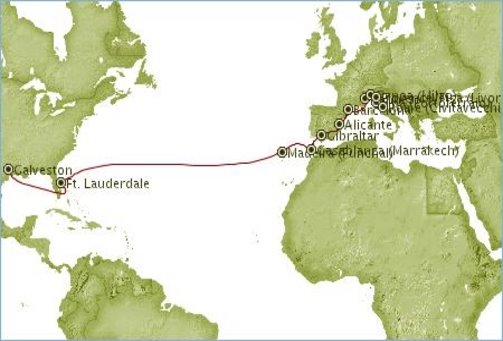 April 17-May 4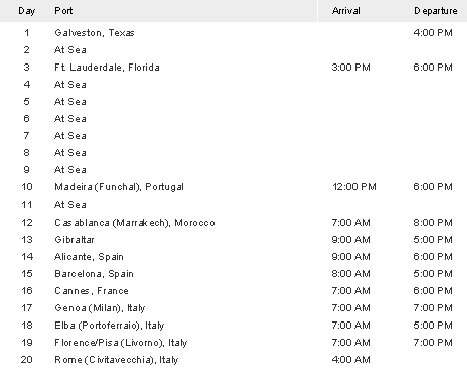
Click on image to enlarge.
Board in Ft. Lauderdale, not Galveston.
Home -- May 4, Midnight.
Subscribe to:
Comments (Atom)